




Why Low-Temperature Foaming Agents Are a Game-Changer for Rubber, EVA & PE
Release time: 2026-01-09
In the fast-paced world of polymer processing, heat is often our greatest ally—and our most persistent enemy. If you’ve ever dealt with scorched rubber, yellowing EVA foam, or deformed PE profiles, you know exactly what I mean. Achieving the perfect expansion without compromising the material’s integrity is a delicate balancing act. This is precisely why the low-temperature foaming agent has transitioned from a niche additive to an industry essential in 2026.
What is a low-temperature foaming agent?
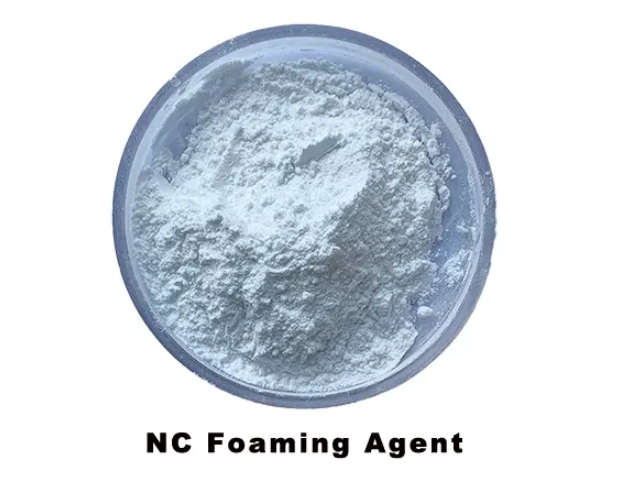
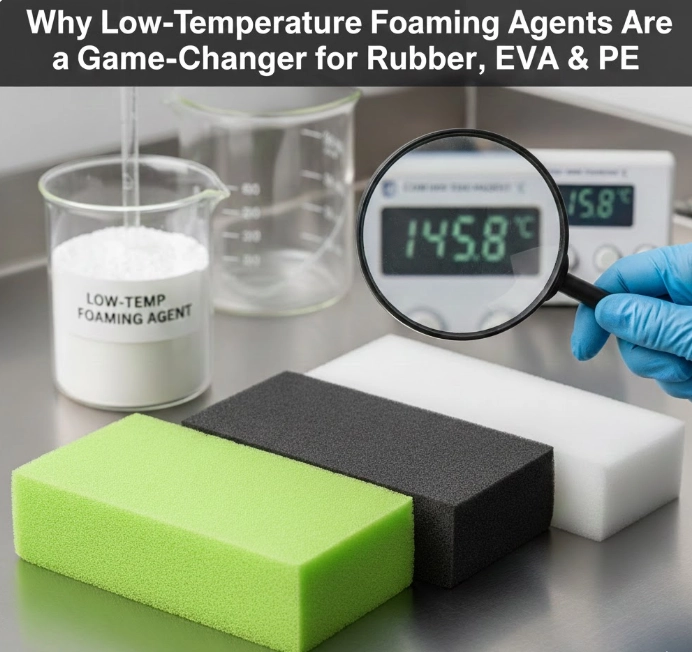
Essentially, a low-temperature foaming agent is a specialized chemical blowing agent designed to decompose and release gas at significantly lower thresholds than standard AC agents. While traditional blowing agents might require temperatures upwards of 200°C, these advanced variants activate between 120°C and 160°C. This lower activation window is critical for heat-sensitive resins, allowing manufacturers to achieve high-quality expansion without pushing the base polymer to its thermal limit.
Why EVA Manufacturers are Making the Switch
For those in the footwear and athletic equipment industry, EVA (ethylene vinyl acetate) is the go-to material. However, EVA is notoriously sensitive to heat. Using a low-temperature foaming agent allows for a much more controlled “cross-linking” process. By keeping the processing temperature low, you minimize the risk of shrinkage and surface defects. The result is a lighter, more resilient foam with a “springy” feel that high-end brands demand for their midsoles and protective gear.
Solving the “Scorching” Problem in Rubber Production
Rubber compounding is a high-stakes environment where “scorch” (premature vulcanization) can ruin an entire batch. By integrating a low-temperature foaming agent, you can align the gas release perfectly with the vulcanization curve of the rubber. This synergy ensures that the bubbles form at the exact moment the rubber matrix is strong enough to hold them, preventing gas escape and resulting in a much more uniform cell structure in products like seals, gaskets, and insulation tubes.
Boosting Efficiency in PE and PVC Extrusion
When it comes to PE (polyethylene) and certain PVC applications, efficiency is the name of the game. Using a low-temperature foaming agent doesn’t just protect the material; it protects your bottom line. Because the extruder doesn’t need to reach extreme temperatures to trigger the foaming, you save significantly on energy costs. Furthermore, lower processing temperatures mean shorter cooling times, which translates directly into faster line speeds and higher daily output for your factory.
How to Implement Low-Temperature Agents Effectively
Transitioning to a low-temperature foaming agent requires a few strategic adjustments to your production line. First, you need to recalibrate your temperature zones to ensure they don’t exceed the agent’s decomposition point too early in the barrel. Secondly, consider the particle size; a high-quality low-temperature foaming agent should have a narrow particle size distribution to ensure consistent gas release. I always recommend running a small-scale trial to find the “sweet spot” where the gas yield matches your desired density.
The Sustainability Edge in 2026
In today’s market, “green” isn’t just a buzzword; it’s a requirement. Lowering your processing temperature by even 20°C across a massive production run results in a measurable reduction in your carbon footprint. By leveraging a low-temperature foaming agent, you aren’t just improving product quality—you are also aligning your brand with global sustainability standards. This makes your products much more attractive to international buyers who are under pressure to meet strict environmental ESG goals.
Final Thoughts: Is It Right for You?
If you are looking to elevate your product quality while cutting down on energy waste, the answer is a resounding yes. Whether you are working with rubber, EVA, or PE, the low-temperature foaming agent offers a level of precision that traditional agents simply can’t match. It’s about working smarter, not harder. Start with a 10-15% substitution in your current formula and monitor the surface finish; you’ll likely find that the improved aesthetics and reduced rejection rate pay for the additive many times over.