




Как пенообразователи и диоксид титана синергетически улучшают качество листов ПВХ и ДПК.
Release time: 2026-02-26
Manufacturing pure white PVC or WPC profiles is a demanding daily task. Extrusion engineers need to constantly balance material weight and surface aesthetics. The real secret lies in your raw materials.
You need precise control over chemical foaming agents and whitening pigments. Specifically, mastering the mixing ratio of high-quality foaming agents and high-grade titanium dioxide is absolutely crucial for success.
1. Choosing the Right Foaming Agent to Enhance Brightness
The chemical foaming agent you choose directly determines the cell structure of the foam board. This internal structure greatly affects how light is reflected on the board and determines its physical strength.
Standard AC foaming agents produce a large amount of gas. However, they often leave a slightly yellowish undertone. This stubborn residue makes it difficult for titanium dioxide to effectively exert its whitening effect.
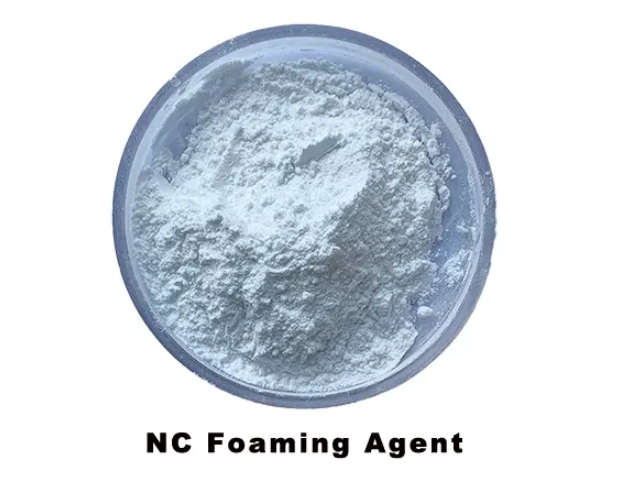
This is precisely why we strongly recommend NC foaming agents. High-quality NC foaming agents decompose very cleanly. It already provides a pure white undertone before you add expensive titanium dioxide.
2. Titanium Dioxide: The Ultimate Whitening Weapon
When we talk about true hiding power, titanium dioxide is the undisputed king. Rutile titanium dioxide provides superior UV resistance and excellent light-scattering properties for outdoor applications.
Adding titanium dioxide perfectly conceals the internal porous structure created by the foaming agent. It ensures that your final WPC or PVC product looks dense, bright, and premium.
But titanium dioxide is indeed expensive. A skilled formulator must optimize the amount of white titanium dioxide used without disrupting the delicate reaction kinetics of the chemical foaming agent within the barrel.
3. Physical Interaction Between Foaming Agent and Titanium Dioxide
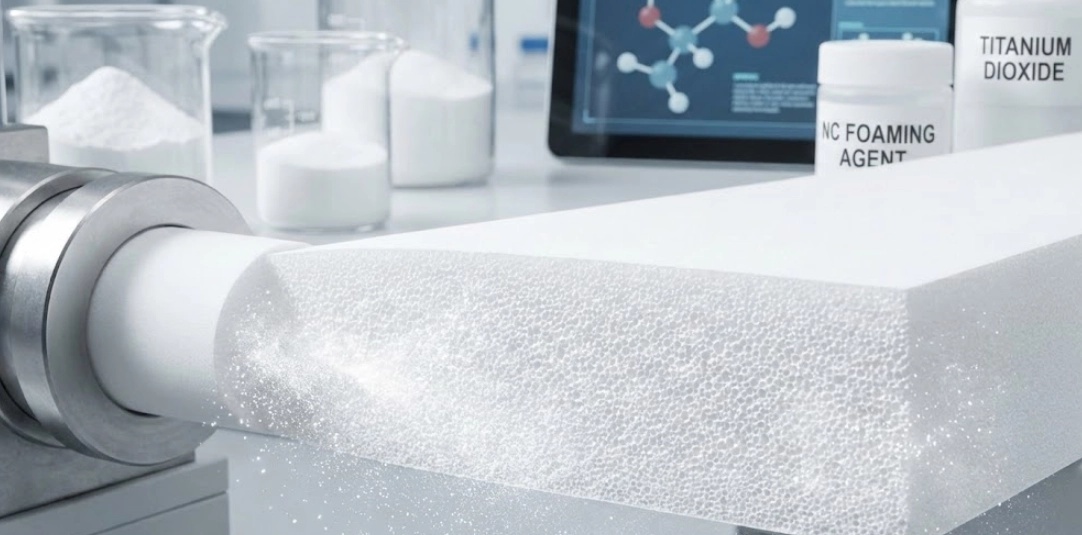
Here’s a technical fact many overlook: titanium dioxide interacts directly with the foaming agent. The fine particles of titanium dioxide act as excellent nucleation sites during extrusion.
This means that titanium dioxide actively helps the gas generated by the foaming agent form smaller, more uniform bubbles. The dense microporous structure significantly improves the overall strength and nail-holding power of the sheet.
However, if your titanium dioxide clumps, it will ruin everything. Poorly dispersed titanium dioxide leads to uneven gas release from the foaming agent, resulting in unsightly surface pitting and internal voids.
Proper dispersion of titanium dioxide is non-negotiable. You must use your titanium dioxide and foaming agent in conjunction with high-quality PVC processing aids and specialized polymer lubricants.
4. Solving Common Yellowing Problems in Profiles
When PVC profiles yellow prematurely, engineers often mistakenly blame titanium dioxide. However, the root cause is often the selection of the wrong chemical foaming agent during mixing.
If an exothermic blowing agent suddenly releases excessive heat, it can degrade sensitive PVC resin. This severe thermal degradation can completely mask the whitening effect of high-quality titanium dioxide.
By switching to a modified endothermic blowing agent from Xilang, you can lower the internal core temperature. This safely protects the polymer and allows the titanium dioxide to shine with a bright white color without chemical interference.
5. Cost Reduction Strategies in Extrusion Production
Cost reduction is always a top priority for factories. Many operators simply overuse expensive titanium dioxide to mask the inferior cell structure caused by using cheap, low-grade blowing agents.
This habit is a huge waste of money. By upgrading to a high-efficiency NC blowing agent, you can achieve a finer microporous structure, which naturally reflects more ambient light to the human eye.
Therefore, you can actually reduce the amount of heavy titanium dioxide used by up to 15%. Better, smarter blowing agents allow your titanium dioxide to operate at a much higher efficiency on the production line.
6. Xilang’s Synergistic Solution: Premium Additive Packages
At Xilang, we eliminate guesswork in formulation. We specialize in manufacturing high-performance chemical foaming agents and top-grade titanium dioxide for the global rubber and plastics industry.
Our dedicated polymer laboratory continuously tests the precise synergies between our NC foaming agents and rutile titanium dioxide. We know exactly how these key additives perform on real-world, high-speed extrusion lines.
Our customers no longer need to source foaming agents and titanium dioxide from different suppliers; instead, they receive customized additive packages. We guarantee perfect raw material compatibility and ensure absolutely zero foaming defects.
Stop worrying about yellowed sheets or collapsed foam cells. By optimizing how your foaming agents and titanium dioxide work together, you’ll immediately increase the value of your final product and market share.
Let Xilang’s raw material experts upgrade your formulation today. Contact our technical engineering team to confidently test our premium foaming agents and titanium dioxide in your next production run.